
Ono Knife


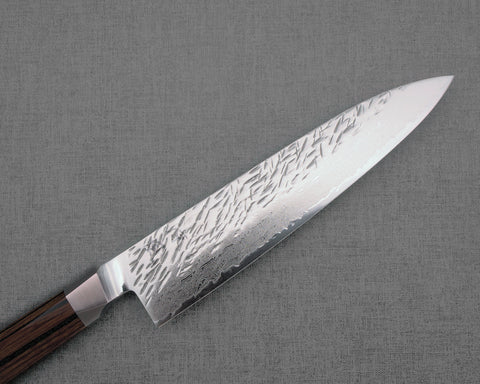


Ono Knife "Suzukaze" R2/SG2 Tsuchime Damascus 150mm Petty
價格:
$5,823.00
The narrow point of the Ono Suzukaze (涼風) 150mm Petty can follow the membrane around a citrus segment without cutting into the flesh on the other side. Behind the point is enough straight edge to halve a shallot and slice it on the board. At about 33mm tall at the heel, the blade leaves the work in view when you trim the hull from a strawberry or lift a strip of silverskin from a tenderloin.
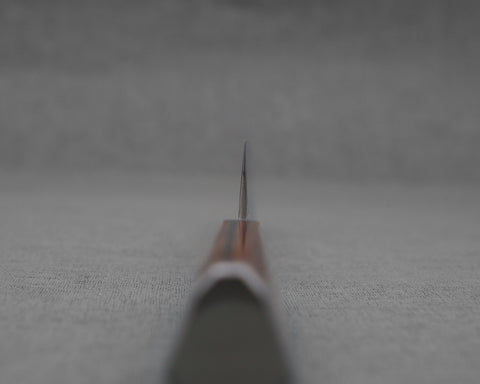
On this slim blade, the hammered marks sit close to the fine waves of the 69-layer Damascus. SG2 powdered stainless steel forms the cutting edge. The tapered, brown-striped Pakkawood handle meets the blade at a metal bolster, just behind the heel.
Spec:
- Origin (Made in): Seki, Gifu Prefecture, Japan
- Brand: Ono Knife
- Series: Suzukaze
- Knife Type: Petty
- Blade
- Construction: San Mai
- Grind: Double-edged Blade (50/50 Grind)
- Hagane (Core Steel): R2/SG2 powdered stainless steel
- Jigane (Cladding): Stainless Damascus; 69-layer construction
- Hardness: 62–63 HRC
- Blade Finishes
- Tsuchime (hammered)
- Damascus
- Blade Length (nominal): 150mm (5.9")
- Cutting Edge Length: Approx. 153mm
- Blade Height (at heel): 33mm
- Spine Thickness
- Above heel: 2.4mm
- Middle: 1.6mm
- 1cm from tip: 1.0mm
- Handle
- Shape: Tapered Western/Japanese hybrid
- Material: Striped brown Pakkawood
- Bolster: Integrated stainless steel
- Length: 110mm
- Overall Length: 270mm
- Weight (unpackaged): Approx. 104g (3.67oz)
- Blade Mark: Printed calligraphic mark 「涼風」
About Ono Knife 大野ナイフ製作所
Ono Knife (大野ナイフ製作所) began in 1916 as a pocketknife workshop in Seki, Gifu Prefecture, making knives for export. In 1995 the company turned to developing premium kitchen knives. Where a blade had traditionally travelled between specialist workshops, Ono brought more than a hundred production steps under one roof. In 2000 it began manufacturing Shun kitchen knives for Kai. The Seki factory pairs machinery with handwork: craftspeople put on the final edge, and experienced inspectors check every finished knife. Suzukaze (涼風), meaning “cool breeze,” carries Ono’s own name.
Care:
Wash and dry with a soft sponge, and safely store after use. Avoid cutting into bones, frozen foods, hard fruit pits.
Cutting Surface:
Recommended cutting surface: wood, rubberized boards and high-end composites, and quality plastics such as polyethene make acceptable cutting surfaces, and will help protect and prolong knife’s edge. AVOID glass, metal, countertops, and other rigid, non-forgiving surfaces.
Sharpening:
We recommend sharpening all quality Japanese knives on whetstones, as we believe they yield the best results for your knives.